What a construction contract should include
A construction contract sets out what will be built, for how much and by when. You sign it once, but every handover record, progress certificate and invoice on the project relies on it. The last payment under it, the retention, can come years after the employer has taken over the works. If a clause is vague, the argument about money or time usually starts when one of those documents is signed.
Where the contract is silent, national law decides, and it differs from country to country. Check it, and do not leave retention to it: write the percentage and the condition for its return into the contract. This article is not legal advice.
Who signs the contract with whom
The usual parties are the employer (the owner, or a company that only invests and commissions the whole project) and the contractor. When the contractor hands part of the works to another firm, the two sign a separate subcontract. The contractor stays responsible to the employer for that work, so the subcontract should carry at least the deadlines, penalties and guarantees owed for the same work. How subcontractors' work is accepted and paid is covered in the guide to subcontractor management in construction.
On large infrastructure projects financed by the EU or by international lenders, the parties usually work under the standard FIDIC conditions, most often the Red Book. Payments, claims and Variations (the FIDIC name for change orders) are covered in the article on FIDIC contracts in construction.
Nine things most contracts settle
- Parties and site. Names, registration numbers and any licence your country requires from builders, and the site tied to the building permit and the approved design.
- Scope. What is built is set out in the bill of quantities attached to the contract: items, quantities and unit rates, and who supplies the materials. If you have no bill yet, start from the bill of quantities template.
- Price. A lump sum or unit rates for the work done and accepted. If the contract does not say which, each side reads the fixed sum and the "approximate" quantities its own way.
- Payment. Usually an advance, interim payments against a progress certificate signed by both parties, and a final payment after Taking Over. The sentence most often missing is how much of the advance comes off each payment.
- Retention. The percentage, the base (with or without VAT), when the money is paid back, and whether the employer may use it for defects the contractor has not fixed.
- Time. A start tied to an event you can prove with a document, most often the site handover, plus the duration, the completion date and the milestones.
- Acceptance. Work is accepted with progress certificates, and the contract says within how many days the employer signs one or returns it with written objections.
- Warranty or defects periods. Set by type of work; check your national law for minimum periods.
- Penalties. A rate per day, a base and a cap, and ideally a penalty for late payment by the employer too.
Which documents refer to the contract during the works
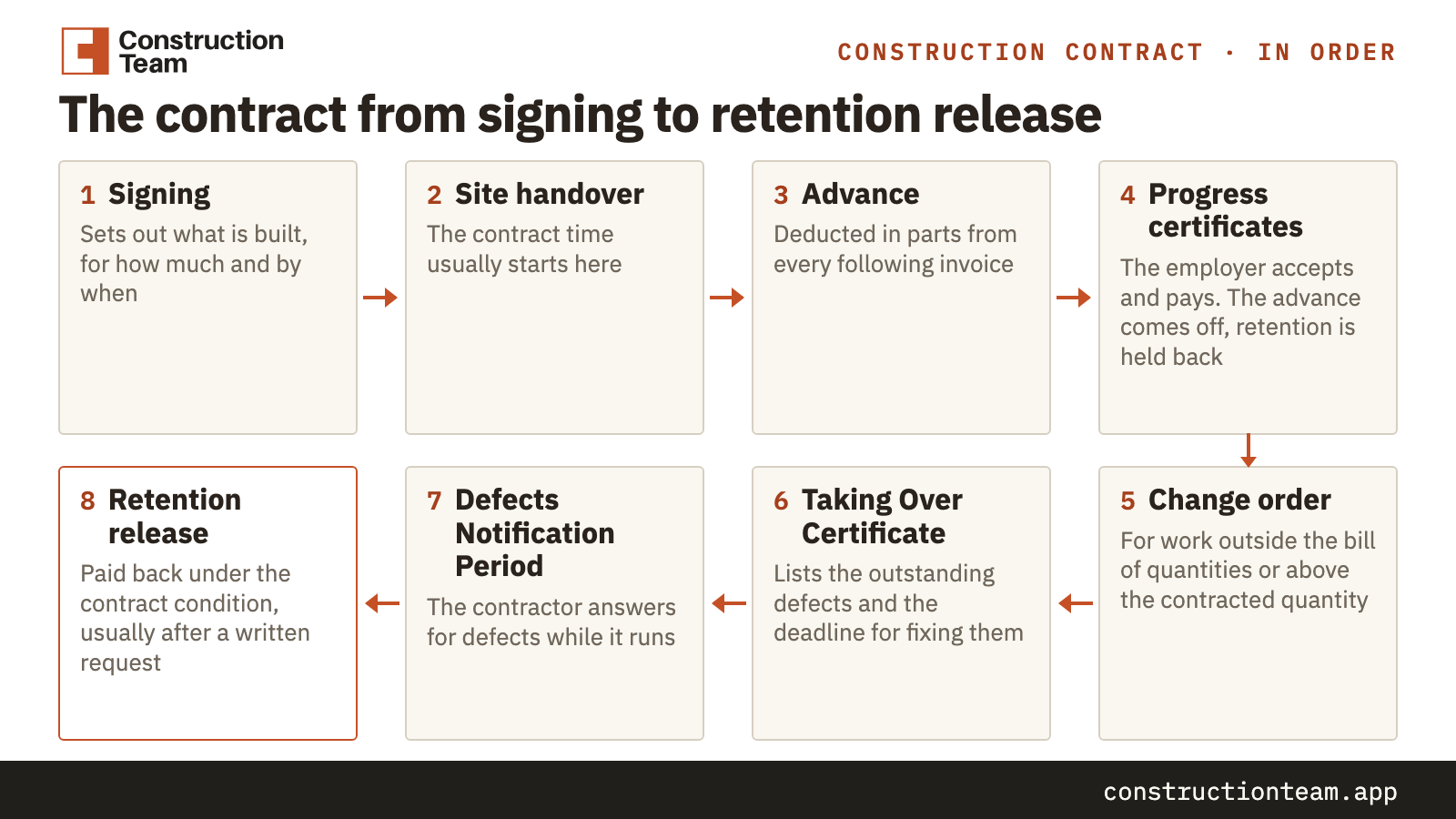
The contract time usually starts with the site handover. If the contract says the time runs from signing and the employer hands over the site, say, two months later, those months count against the contractor.
For each period the employer accepts the completed work with a progress certificate (an Interim Payment Certificate under FIDIC) and pays on it. Work that will be covered up later is inspected and accepted first.
If the works stop for a reason the contractor is not responsible for, record the suspension and the restart in writing, signed by both sides. Without such records it is hard to prove the delay was not the contractor's. Under FIDIC, the contractor has to give notice of a claim for extra time within 28 days of becoming aware of the event.
At the end the employer takes over the works with a Taking Over Certificate, which lists the outstanding defects and the deadline for fixing them. How the contract items reach the progress certificate, which Construction Team calls an act, and then the invoice is shown in the article from the bill of quantities to the act and the invoice.
When the contract needs a change order
Write into the contract that work outside the bill of quantities starts only after a written instruction and a priced change order. If the contract says the quantities are fixed, quantities above them go through a change order as well.
How the advance is deducted and when the retention comes back
The advance is deducted in parts from every following invoice, and the final invoice deducts whatever is left. A worked example is in how to deduct an advance on a construction contract.
With retention, the employer holds back a percentage of every interim payment and pays the total back once the condition in the contract is met. Under FIDIC it is typically 5% of each certificate, half released at Taking Over and half at the end of the Defects Notification Period. Performance security is a different thing: the contractor provides it at the start, as a bank guarantee or a surety bond, while retention builds up from payments for work already accepted.
When a construction contract ends
The final payment follows Taking Over, but the warranty or defects periods run on, and the contractor answers for defects while they do. Under FIDIC the Defects Notification Period is typically 365 days. In some countries the law sets much longer periods for structural work.
The retention need not be held that long, and parties often agree to return it well before the longest warranty runs out.
Retention is rarely paid back by itself, though. The contractor usually has to ask in writing, years later, when the people who ran the project may have left, so the company has to track the dates itself. Claims for money also expire after a limitation period set by national law. For the contractor, the contract ends when the warranty periods have expired and the last retained amount has been paid.
How the contract is managed in Construction Team
With the contract in a folder, the advance, retention and remaining quantities are worked out by hand. In Construction Team, software for managing construction projects, you enter the contract in the construction contracts module and create the acts and the invoices from it. The software suggests how much of the advance to deduct and calculates the retention on every act.
A contract from a won tender is created with the tender data. It holds the site, the parties, the value, the dates, the payment terms, the warranty period and the retention percentage.
When an act goes over the contracted quantity, a switch on the contract decides what happens. With the switch off, which is the default, the act goes through once you confirm the extra quantity. With it on, the act cannot be approved until a change order covers the extra, though you can still save it as a draft.
One side proposes a change order and the other approves or rejects it, and every request leaves a record. The change order records the contract value before and after the change. When you approve a new end date, the software moves the unfinished items in the schedule and the tasks.
There is no cap at which retention stops accruing by itself, and the software does not split the release into two halves on its own. Each release is a separate request that someone approves, and it cannot exceed what has been retained.
A contract already signed on paper is uploaded as a scan in the AI Document Import screen. The software recognises it as a contract, reads the data and shows it to you for confirmation before it creates the record, so nobody retypes it.
Related Articles
- Subcontractor Management in Construction
- FIDIC Contracts in Construction
- How to deduct an advance on a construction contract
- Bill of Quantities (BOQ) Template
- From the bill of quantities to the act and the invoice
- Construction contracts software
Register for free and run the contract together with its acts, invoices and retention.
Frequently asked questions
Which documents during construction refer back to the contract?
Several documents rely on the contract. The contract time usually runs from the site handover. For each period the employer accepts and pays for the work with a progress certificate (an Interim Payment Certificate under FIDIC). Any suspension and restart of the works is recorded in writing, and at the end the Taking Over Certificate lists the outstanding defects.
What should a construction contract include?
It should name the parties and the site and set out the scope in a bill of quantities. It also fixes the price and the payment terms, the retention, the time for completion, how the work is accepted, the warranty or defects periods and the penalties for delay. For retention and penalties, write exact percentages, the base they apply to and the dates, or each party will read them its own way.
When does a construction contract need a change order?
When work outside the bill of quantities is needed, or more than the contracted quantity. It helps if the contract says that the contractor starts such work only after a written instruction and a priced change order.
When does a construction contract end?
After the final payment, the warranty or defects periods still run. The employer returns the retention under the condition in the contract, usually after the contractor asks for it in writing. For the contractor, the contract ends when those periods have expired and the last retained amount has been paid.
Want to see the system with your own numbers?
Construction Team keeps the bill of quantities, the offer, the progress certificate and the invoice in one system, with no retyping. Answer six short questions and we will show you how.
Request a demo